
1 min read
What is The True Cost of Skipping Business Jet MRO & Maintenance?
Routine private aircraft maintenance is a critical factor in flight safety, operational readiness, and asset value. Deferred maintenance may...
Washington D.C.’s most established FBO, delivering secure hangar
space, reliable fuel, and efficient ground support just 36 miles
from downtown DC.
Management, maintenance, charter, and sales services designed
to keep your aircraft compliant, supported, and ready to fly.
Learn who we are, how we operate, and access resources built
to help aircraft owners, operators, and flight departments make
informed decisions.
5 min read
Chantilly Air
:
July 29, 2026
Table of Contents
|
Private jet maintenance is one of the largest recurring costs of aircraft ownership, but with the right approach, it's also one of the most predictable. Business jet maintenance costs vary widely by aircraft size, age, and how often you fly, while every jet follows a set aircraft inspection schedule built around standard jet maintenance intervals, and the upkeep is generally tax-deductible in proportion to business use. |
Private jet maintenance typically runs $200,000–$500,000 per year for light jets, $500,000–$1.5 million for midsize and super-midsize aircraft, and $1 million or more for large-cabin jets, before unscheduled repairs.
Maintenance is one of the highest recurring costs of aircraft ownership, and it scales with the size and complexity of the aircraft. Industry estimates vary widely, but as a general guide, annual maintenance commonly falls in these ranges:
|
Aircraft Class |
Typical Annual Maintenance |
Example Types |
|---|---|---|
|
Light jet |
$200,000 – $500,000 |
Cessna Citation CJ, Learjet 30/40 series |
|
Midsize / super-midsize |
$500,000 – $1.5 million |
Hawker 800, Citation XLS, Challenger 300 |
|
Large-cabin / long-range |
$1 million+ |
Large-cabin Bombardier and comparable jets |
Ranges reflect commonly cited industry figures and vary significantly by aircraft; they are not quotes. Actual maintenance cost is best benchmarked against operating-cost data for a specific make and model.
These figures cover scheduled maintenance and routine upkeep, not the full cost of ownership — premium fuel, crew, insurance, and secure hangar space are separate. Two identical airframes can carry very different maintenance bills depending on how hard each is flown and how it has been cared for, and major engine overhauls alone can exceed $1 million. For a precise figure, maintenance is best estimated against a specific aircraft's make, model, age, and utilization.
Private jet maintenance costs are driven primarily by four factors: how much the aircraft flies, its age and condition, whether it's enrolled in engine and airframe programs, and unscheduled events.
Each one moves the number in its own way.
Utilization. Many components are tracked by flight hour or cycle, so an aircraft flying 400 hours a year accrues maintenance faster than one flying 150.
Age and condition. Older aircraft and pre-owned airframes tend to require heavier, more frequent work as parts reach the end of their service life.
Engine and airframe programs. Hourly-cost programs (such as JSSI, Rolls-Royce MSP, or Honeywell TAP) convert large, irregular expenses into a predictable per-hour reserve. Enrollment adds cost predictability and protects resale value — non-enrolled aircraft often sell at a discount.
Unscheduled events. An aircraft-on-ground (AOG) situation — an unexpected fault that grounds the jet — can arrive with little warning, which is why responsive AOG support is worth budgeting for.
A business jet is inspected on a recurring schedule built from flight-hour, calendar, and cycle intervals — most commonly every 100 flight hours, every 12 calendar months, or in phased intervals spread across the year, depending on the aircraft and how it's flown.
The FAA's baseline inspection framework under 14 CFR 91.409 defines three familiar types:
In practice, most turbine business jets go beyond this baseline and follow a manufacturer-defined maintenance program. These programs organize work into phase inspections keyed to a mix of flight hours, calendar time, and cycles (takeoffs and landings), and layer in engine-specific events such as hot-section inspections and overhauls. The right program for a given aircraft depends on its make, model, and how it's operated — which is why inspection schedules are tailored aircraft by aircraft rather than applied one-size-fits-all.
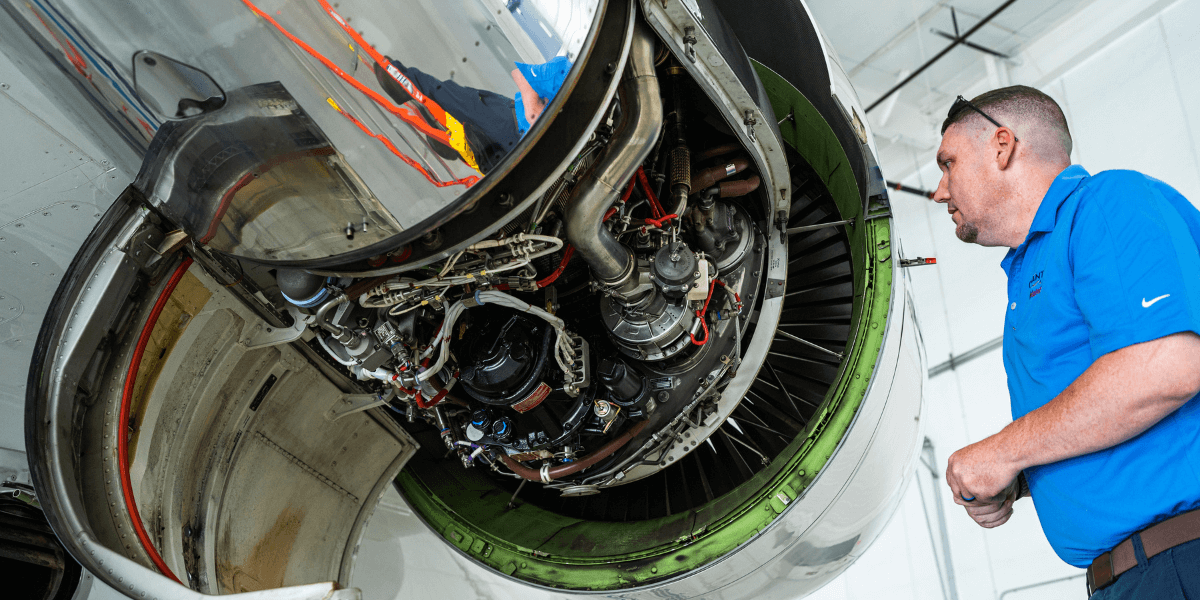
An aircraft inspection includes a structured review of the entire aircraft — the airframe and structure, engines, avionics and instruments, and core systems such as landing gear, flight controls, and pressurization — checked against manufacturer specifications, airworthiness directives, and FAA requirements.
At an FAA Part 145 repair station, that work is performed under documented capabilities and specific regulatory approvals. Chantilly Air's in-house scope, for instance, includes engine borescope evaluations, non-destructive inspection (NDI), and airframe damage repair, alongside the instrument and avionics testing an aircraft needs to stay RVSM-compliant — altimeter checks in accordance with FAR 91.411, transponder and air data computer checks in accordance with FAR 91.413, pitot-static inspection, and pitot probe alignment.
The goal is singular: return the aircraft to service airworthy, compliant, and ready for the next mission.
In most cases, yes — when the aircraft is used for legitimate business purposes. Maintenance is generally treated as an operating expense that's deductible in proportion to the aircraft's qualified business use, alongside costs like fuel, insurance, and crew. Personal and entertainment use is not deductible, and the business-versus-personal line has drawn heightened IRS scrutiny in recent years.
Separately, the 2025 tax law restored 100% first-year bonus depreciation on qualifying business aircraft placed in service after January 19, 2025 — a significant benefit tied to the aircraft itself rather than its upkeep. Because tax treatment depends heavily on ownership structure and use, this is territory for a qualified aviation tax professional; the above is general information, not tax advice.
Chantilly Air is a full-service FAA Part 145 repair station providing private jet maintenance and MRO at Washington Manassas Airport (formerly Manassas Regional Airport, KHEF), just outside Washington, D.C.
For more than three decades, we've kept business aircraft airworthy and ready to fly, with inspections, repairs, and records all under one roof. Our technicians train through manufacturer-approved programs including FlightSafety International, and our maintenance work has been recognized by the FAA with a Diamond Award of Excellence. Pairing scheduled inspections, avionics, and priority AOG support with in-house management and hangar means fewer handoffs, tighter turn times, and a clear line of sight on what's due and what it will cost.
To discuss an inspection program built around your aircraft, explore our Part 145 maintenance and MRO services.
Scheduled maintenance is planned work driven by the inspection calendar — flight-hour, calendar, and cycle intervals known well in advance. Unscheduled maintenance addresses faults that arise unexpectedly, such as an AOG event, and is the harder line item to predict, which is why owners budget a reserve for it.
Engine and airframe programs don't necessarily lower total cost, but they make it predictable by converting large, irregular expenses into a fixed hourly reserve. They also protect resale value, since program-enrolled aircraft typically command stronger prices than non-enrolled ones.
Generally, yes. As an airframe ages and components approach the end of their service life, inspections tend to surface more required work, and some maintenance events grow heavier. A pre-purchase inspection is the best way to understand an older aircraft's likely maintenance profile before you buy.
It varies by aircraft type and the scope of the event, from a routine phase check to a heavy inspection. Programs like progressive inspection are designed specifically to reduce single-event downtime by spreading work across the year, and efficient scheduling at the maintenance facility has a large effect on turn time.
An aircraft is airworthy when it conforms to its approved type design and is in condition for safe operation. Returning an aircraft to airworthy status — verified and documented — is the purpose of every inspection.
Sources:
Federal Aviation Administration. "14 CFR § 91.409 — Inspections." Electronic Code of Federal Regulations. https://www.ecfr.gov/current/title-14/chapter-I/subchapter-F/part-91/subpart-E/section-91.409
Internal Revenue Service. "Treasury, IRS Issue Guidance on the Additional First Year Depreciation Deduction Amended as Part of the One, Big, Beautiful Bill." January 14, 2026. https://www.irs.gov/newsroom/treasury-irs-issue-guidance-on-the-additional-first-year-depreciation-deduction-amended-as-part-of-the-one-big-beautiful-bill
1 min read
Routine private aircraft maintenance is a critical factor in flight safety, operational readiness, and asset value. Deferred maintenance may...
1 min read
A Part 145 repair station is more than a regulatory checkbox. It's how the FAA tells you a maintenance facility has been audited, approved, and...
1 min read
If you're looking for an FBO near Washington, D.C., Manassas Regional Airport (KHEF) is usually faster and easier than Dulles for private...